How to write titles and meta descriptions that get clicks on Google

Showing up on Google is only half the job. The other half is getting people to choose your result out of ten. That depends largely on two pieces of text: the title and the description Google shows for your page. They're your shop window: if they don't say anything interesting, people walk past.
If Google Search Console shows your site gets lots of impressions but few clicks, this is probably your quickest win.
What the title and meta description are
- The title (the
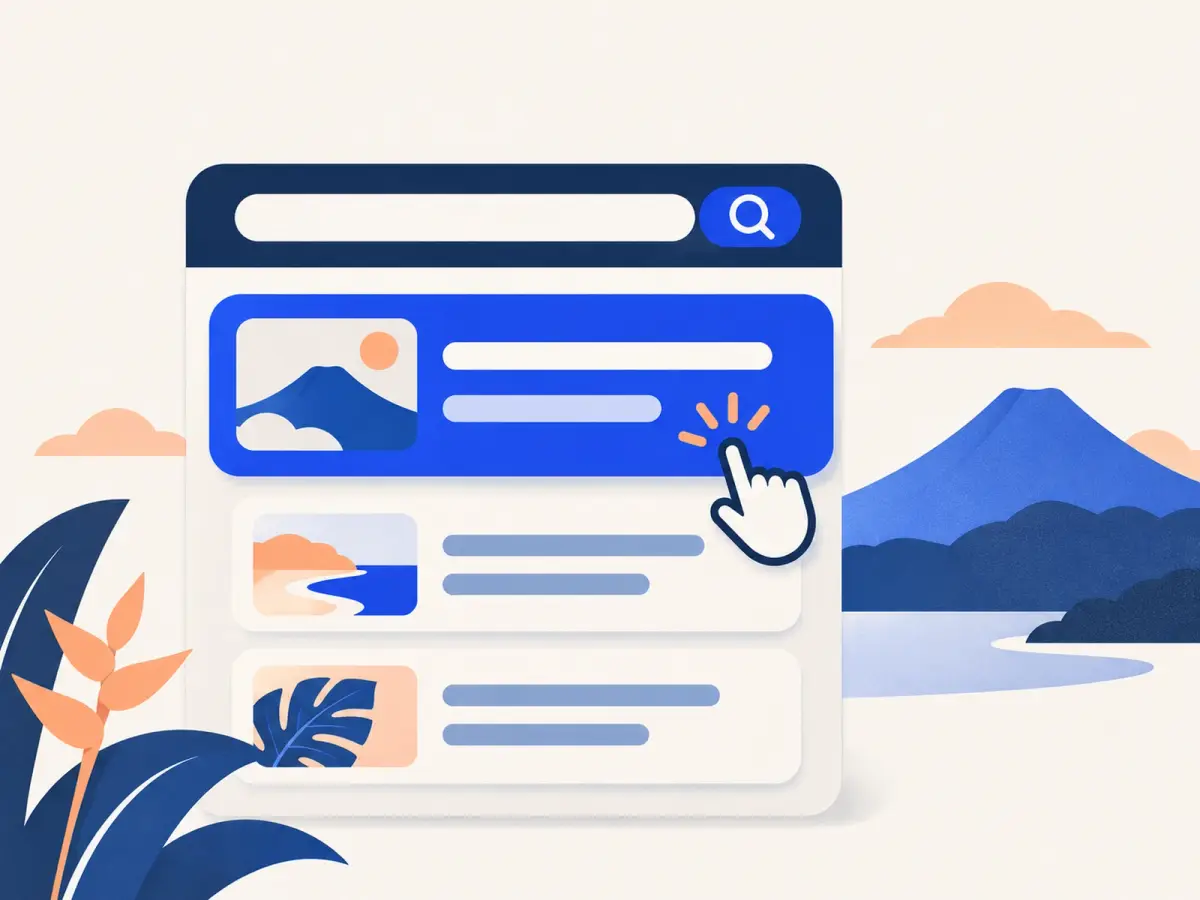
titletag) is the large blue text in the result. It's also one of the strongest signals helping Google understand what the page is about. - The meta description is the two-line text below the title. It doesn't directly affect ranking, but it does influence whether people click.
Google may rewrite either one if it thinks other text on the page answers the search better. A good title and description make that less likely.
How to write a good title
- Say exactly what the page is, in your customers' words: "Small business accounting in San José", not "Comprehensive solutions".
- Put the important part first. On mobile, titles get cut off; the start has to work on its own.
- Add a differentiator where it makes sense: the area, the year, a concrete benefit, "guide", "prices".
- Make it unique: every page needs its own title.
- Don't repeat keywords or cram terms separated by pipes.
- Rough length: around 50 to 60 characters usually displays in full. It's not an exact rule: Google measures width in pixels.
Examples:
| Before | After |
|---|---|
| Home | Pest control in Heredia and Alajuela · Same-day service |
| Services | Small business accounting in San José: returns and payroll |
| Blog – Article 12 | How to get a building permit in Costa Rica (2026 guide) |
How to write a good description
- Answer the searcher's question: what they'll find on the page.
- Include a concrete detail: starting price, area, hours, delivery time, guarantee.
- Invite action naturally: "See prices", "Book a consultation", "Find out the steps".
- Rough length: around 140 to 160 characters.
- A different description for every page.
Example:
Pest control for homes and businesses in Heredia and Alajuela. Get a WhatsApp quote in minutes and a same-day visit. Pet-safe products.
Common mistakes
- The same title on many pages (for example, just the company name everywhere).
- Titles that promise something the page doesn't deliver: people click, don't find it and leave.
- All caps or excessive punctuation.
- Empty, copied or generic template descriptions.
- Changing titles that already work without checking the data.
How to measure whether it worked
- In Google Search Console, under Performance, filter by the page and note clicks, impressions, CTR (click-through rate) and position for the last 4 weeks.
- Change the title and description.
- Wait for Google to recrawl the page (you can request it from URL Inspection).
- Compare the same metrics 4 weeks later.
If position held steady and CTR went up, the change worked. Change a few pages at a time so you know what made the difference. More in how to use Google Search Console.

Beyond the title: rich results
Structured data can make your result show extra information such as star ratings, price, availability or breadcrumbs. It's not guaranteed, but when it appears, your result takes up more space and stands out. See our technical SEO guide.
Frequently asked questions
Why isn't Google showing the title I wrote?
Google sometimes replaces it with other text from the page (for example, the main heading) if it thinks that describes the content better for that search. A clear title that matches the page's heading makes this less likely.
Does the meta description improve my ranking?
Not directly. But a better CTR means more visitors from the same position.
How often should I review my titles?
Whenever Search Console shows pages with lots of impressions and a low CTR, or when you change a page's content.
Want help?
In our plans we review titles and descriptions using your real Search Console data. See our prices or get in touch.
Rather talk first? Book a free video call or price your project.
Keep reading
 Online Marketing · November 4, 2026How to measure SEO results: the metrics that matterWhich metrics show whether SEO is working: visibility, clicks, visits, enquiries and sales. How to measure them with Search Console and Analytics, and what to expect month by month.
 Online Marketing · November 3, 2026A website in Spanish and English: how to do bilingual SEO in Costa RicaHow to set up a site in Spanish and English so Google shows each person the right language: a URL per language, hreflang, adapted (not just translated) content and English searches.
 Online Marketing · November 3, 2026How to do keyword research step by step (with free tools)How to find the keywords your customers in Costa Rica use, understand search intent and choose which ones to focus on, using free tools.